How to Stop Losing Money to No-Shows and Cancellations in Your Salon or Barbershop
Every salon and barbershop owner in Kenya knows this feeling. It is Saturday morning. You turned down a walk-in because your 10am slot was booked. Then 10:15 comes. Then 10:30. No one walks in. The chair sits empty. The money is gone.
No-shows and last-minute cancellations are one of the biggest silent revenue killers for beauty businesses in Kenya. And unlike slow seasons or rising product costs, this one is entirely preventable.
If you run a salon, barbershop, nail studio, or beauty parlour in Kenya, this guide will show you exactly how to reduce no-shows, protect your income, and build a booking process that clients actually respect.
How Much Are No-Shows Really Costing Your Salon?
Before we get into solutions, let us do the math in numbers that actually matter to you.
Industry research shows that roughly 30% of salon appointments are missed or cancelled every year. For beauty businesses in Kenya, the impact adds up fast.
Let us say your average service costs KES 2,000. If just 2 clients per week do not show up, that is KES 16,000 per month. Over a full year, that is KES 192,000 lost — simply because people did not show up.
To put that in perspective, KES 192,000 is close to two months of rent for many Nairobi salon locations. It could cover restocking your products for a quarter. Or it could be reinvested into marketing that brings in new clients.
The real cost goes even further. When a client does not show up:
- Your stylist or barber assigned to that slot earns nothing, especially if they work on commission
- You may have turned away a walk-in or another booking for that same time
- Your team's morale takes a hit because their time and income were wasted
- Over time, your best staff may leave for a business that manages bookings better
No-shows are not just a scheduling inconvenience. They are a direct threat to your salon's revenue, your team's trust, and your ability to grow.
Why Clients Don't Show Up (It's Not Always What You Think)
To reduce no-shows at your salon in Kenya, you first need to understand why they happen. The reasons are often simpler than you would expect.
1. They Forgot
This is the number one reason across the industry. Research suggests that 62% of no-shows happen because the client simply forgot about their appointment. Life gets busy. If there is no reminder, the appointment slips from their mind.
2. There Was No Real Commitment
When a client books through a quick WhatsApp message and gets a thumbs-up in return, the appointment feels informal. There is no confirmation step, no deposit, no follow-up. It is easy to treat an informal promise as optional.
3. Something Came Up and They Did Not Know How to Cancel
Sometimes clients genuinely want to let you know they cannot make it, but they feel awkward about it. If there is no easy way to reschedule or cancel, they may just avoid the conversation altogether.
4. The Walk-In Mentality
In Kenya, many salons still operate on a walk-in basis. Clients who are used to this model do not place the same weight on a booked appointment. Booking feels like a suggestion, not a commitment.
5. No Consequences for Not Showing Up
If nothing happens when a client misses their appointment, there is no reason for them to prioritise it next time. The cycle continues.
Understanding these reasons is important because the solutions are not about punishing clients. They are about building systems that make it easier for clients to follow through.
7 Proven Ways to Reduce No-Shows and Cancellations at Your Salon or Barbershop
Here are practical, tested strategies that work specifically for beauty businesses in Kenya. Each one is designed to be respectful, professional, and easy to implement.
1. Send Appointment Reminders (The Single Most Effective Fix)
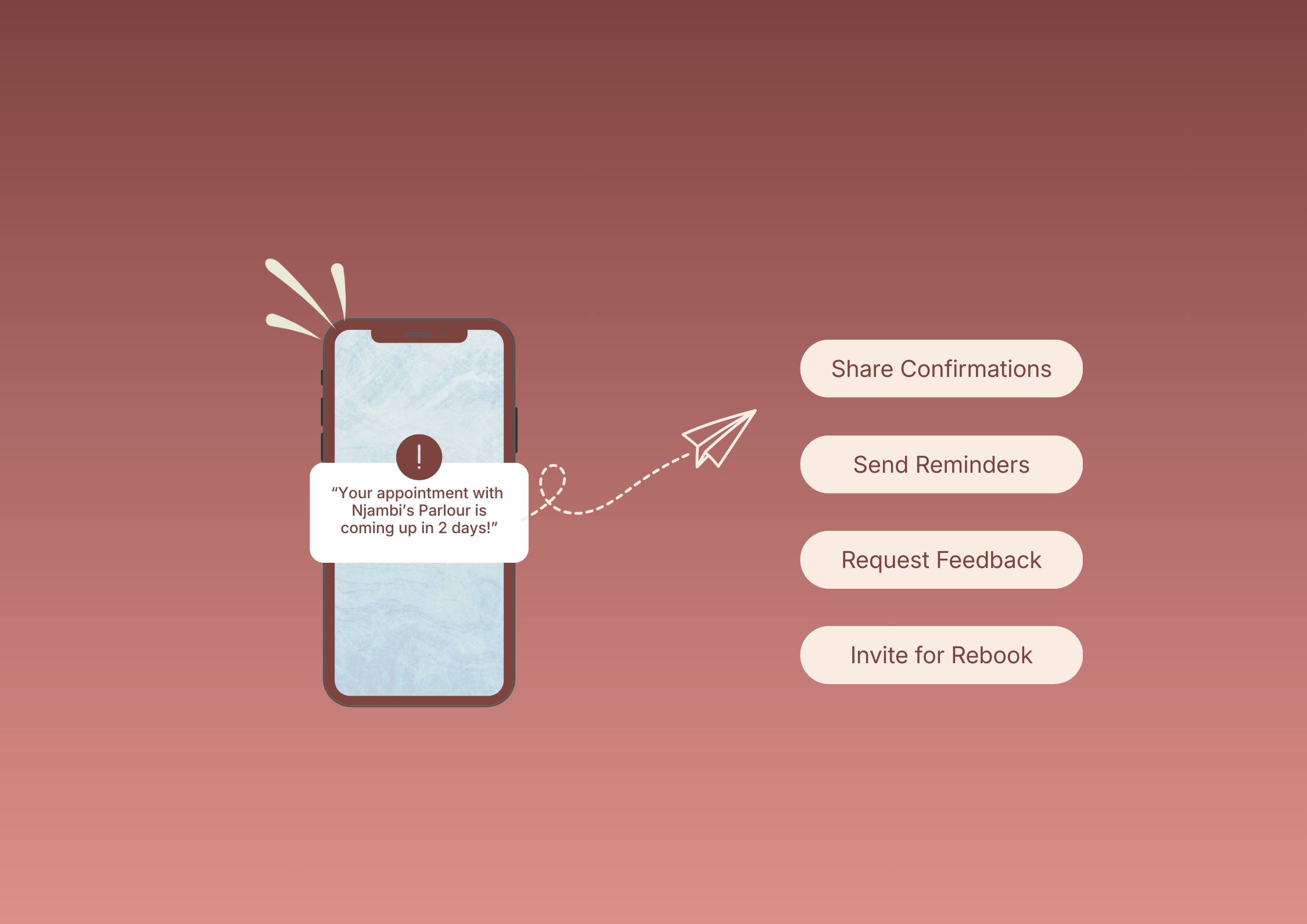
Automated appointment reminders can reduce no-shows by 29% to 50%, according to multiple industry studies. And in a market where most salons send zero reminders, this gives you an immediate advantage.
What works best in Kenya: WhatsApp and SMS reminders outperform email because text-based messages have open rates above 90%. Most of your clients are already on their phones throughout the day.
When to send them:
- Confirmation message immediately after booking
- First reminder 24 to 48 hours before the appointment
- Final reminder 2 to 4 hours before the appointment
Sample WhatsApp reminder you can use:
Hi [Client Name]! Just a friendly reminder that your appointment at [Salon Name] is tomorrow, [Day] at [Time]. If you need to reschedule, please let us know at least 24 hours in advance. We look forward to seeing you!
The key is consistency. When clients know that your salon follows up, they take bookings more seriously from the start.
2. Set Up a Clear Salon Cancellation Policy
A cancellation policy is not about being strict. It is about being professional. The most respected salons and barbershops in Kenya have clear boundaries, and clients appreciate knowing exactly where they stand.
What your salon cancellation policy should include:
- A minimum notice period for cancellations — 24 hours is standard, 48 hours for high-ticket services like braids, locs, or colour treatments
- What happens if someone cancels late or does not show up (for example, a rebooking fee or forfeited deposit)
- How clients can reschedule easily
How to communicate it without awkwardness:
- Share it in your booking confirmation message
- Include it on your booking page or link
- Post it to your social media highlights on Instagram or pin it on TikTok
The goal is not to surprise anyone. When clients know the policy before they book, they respect it.
3. Collect a Small Deposit to Secure Bookings
This is the strategy salon owners in Kenya are most hesitant about, yet it is one of the most effective. Research shows that salons using deposits see no-shows drop by as much as 29%.
Why it works: When a client has paid something upfront, even a small amount, the appointment shifts from a casual plan to a financial commitment.
How to do it with M-Pesa:
A simple process looks like this:
- Client books an appointment
- You send a confirmation message with deposit instructions: "To confirm your booking, please send a deposit of KES [amount] to [Till/Paybill number]"
- Once the deposit is received, the booking is confirmed
- The deposit is deducted from the total service cost on the day of the appointment
How much to charge: A deposit of 20% to 30% of the service cost is standard and feels fair. For a KES 3,000 service, that is KES 600 to KES 900.
How to frame it to clients:
"We collect a small deposit to secure your time slot. It is deducted from your total on the day of your visit. This helps us manage our schedule so we can give every client the attention they deserve."
A deposit does not make you strict. It makes you serious about your business.
4. Make Rescheduling Easier Than Cancelling
One of the most overlooked strategies is this: if you make it simple for clients to move their appointment, they are far less likely to just disappear.
Many clients who become no-shows did not intend to miss their appointment. They just did not have a quick, guilt-free way to reschedule. If rescheduling requires a back-and-forth on WhatsApp or an awkward explanation, most people will take the path of least resistance and simply not show up.
What you can do:
- Include a "Need to reschedule?" link or option in every reminder message
- Use an online booking system that allows clients to move their own appointments
- Set a clear cut-off time for free rescheduling — for example, "Reschedule for free up to 24 hours before your appointment"
When rescheduling is easy, you keep the client. When it is hard, you lose both the client and the revenue.
5. Track No-Show Patterns and Take Action
Not all no-shows are equal. Some clients are one-time offenders who had a genuine emergency. Others are repeat offenders who treat your time as disposable.
What to track:
- Which clients have missed appointments more than once
- Which days and times have the highest no-show rates
- Whether certain services or booking channels have more no-shows
What to do with this information:
- For first-time no-shows, send a friendly follow-up and rebook them
- For repeat offenders, require a deposit for future bookings or flag them in your system
- If certain time slots have high no-show rates, consider adjusting your schedule
You cannot fix what you do not measure. Even a simple notebook or spreadsheet tracking who did not show up will reveal patterns that help you make smarter decisions.
6. Reward Clients Who Show Up Consistently
While it is important to manage no-shows, it is equally valuable to recognise the clients who always keep their appointments.
Simple ideas that work:
- A loyalty discount after a certain number of consecutive kept appointments
- Priority booking access for reliable clients
- A small thank-you gesture on their next visit — a complimentary conditioning treatment or product sample
This creates a positive cycle. Clients who feel valued for showing up will continue to show up.
The WhatsApp Booking Problem (And How to Fix It)
Most salons and barbershops in Kenya rely on WhatsApp as their primary booking system. And while WhatsApp is convenient, it is not a booking system. Here is why it creates no-show problems:
- No structure. A message that says "Book me for Thursday" has no confirmation step, no reminder trigger, and no record that can be tracked.
- No accountability. If the client does not show, there is no trail. You cannot even prove the booking existed.
- No automation. You cannot send automated reminders, collect deposits through the chat, or manage cancellations systematically.
- Messages get buried. In a busy salon, client booking messages mix with supplier chats, personal messages, and group notifications. Appointments slip through the cracks.
The fix is not to abandon WhatsApp entirely. Your clients love it, and it is where conversations naturally happen. The fix is to move the actual booking process to a system that handles confirmations, reminders, and policies automatically — while keeping WhatsApp as your communication channel.
This is exactly what tools like Nia Booking are built to do: give your clients a clean, professional booking experience while giving you the systems to protect your time and revenue behind the scenes.
How to Enforce Policies Without Losing Clients
This is the part that feels hardest for many salon owners in Kenya. The client-stylist relationship here is personal. Your regulars are not just customers — they are your people. Charging for no-shows or enforcing cancellation policies can feel like it might damage that relationship.
Here is the mindset shift that changes everything: policies are not punishment. They are mutual respect.
When you have clear booking systems and policies, you are communicating something powerful to your clients: "I take my business seriously, and I respect your time enough to be organised."
Practical tips for enforcing policies without awkwardness:
- Lead with the system, not personal confrontation. Instead of "I'm going to charge you for not showing up," let the system communicate: "Our booking policy includes a 24-hour cancellation notice. Here's how to reschedule easily."
- Apply policies consistently. When everyone is treated the same, no one feels singled out. Inconsistency breeds resentment.
- Start gently. For your first implementation, communicate the new policy, send reminders, and only enforce consequences after a grace period of two to four weeks.
- Frame it around the client's benefit. "This policy helps us make sure your preferred time slot is always available when you need it."
You do not lose clients by having policies. You lose them by having no systems.
From Walk-Ins to Bookings: Making the Shift
If your salon currently runs mostly on walk-ins, the idea of moving to an appointment-based model can feel risky. What if clients do not book? What if you lose the spontaneous traffic?
The good news is that you do not have to choose one or the other. The most successful salons in Kenya operate a hybrid model that combines the best of both approaches.
How to transition gradually:
- Start by encouraging bookings for high-demand slots. Saturday mornings, lunch hours, and after-work slots fill up fast. Reserve these for booked clients and accept walk-ins during quieter periods.
- Make booking easy and fast. If booking takes more than 60 seconds, clients will default to walking in. A simple online booking page eliminates friction.
- Promote booking as a VIP experience. "Book ahead and skip the wait" is a compelling message, especially when the average salon wait time in Nairobi can reach 50 minutes.
- Track the difference. Over time, you will notice that booked clients are more predictable, more committed, and more profitable than walk-ins. Let the data guide your shift.
The walk-in model keeps you busy. The booking model keeps you profitable. Having both gives you control.
Protect Your Revenue with the Right Tools
Everything in this article can be done manually. You can send WhatsApp reminders by hand, track no-shows in a notebook, and collect M-Pesa deposits one at a time. Many salon owners in Kenya do exactly this, and it works — up to a point.
But as your business grows, manual systems break down. Messages get missed. Deposits go untracked. Policies are enforced inconsistently. And the very problem you are trying to solve — lost revenue from no-shows — continues quietly draining your income.
This is where a booking and client management platform makes the difference. With Nia Booking, you can:
- Send automated confirmations and reminders so clients never forget their appointment
- Set and communicate your cancellation policy as part of the booking flow
- Manage your team's schedule and availability so every slot is accounted for
- Track booking history and client records to spot patterns and build loyalty
- Offer clients a professional booking experience that reflects the quality of your salon
Automate reminders and protect your revenue with Nia Booking. Set up your booking in minutes and start reducing no-shows from day one.
Frequently Asked Questions
Try Nia today and see how it fits into your business
Set up online booking, manage clients, and streamline your operations without complexity.
Get started